

Should Yoga Be an Olympic Sport? Eight Reasons Why Not
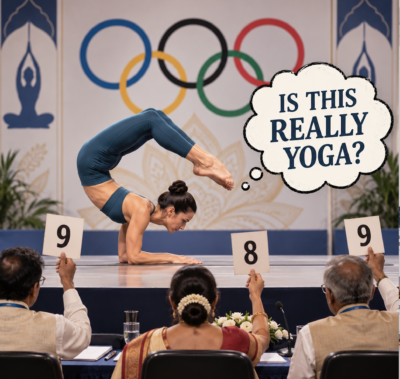
The growing campaign to make Yoga an Olympic sport is, to my mind, a troubling development in modern Yoga.
I was recently quoted in The Guardian in an article examining the controversy surrounding competitive Yoga and its ambitions for Olympic recognition.
Having practised Yoga since 1999 and taught it since 2006, I have watched the practice become increasingly associated with physical fitness, flexibility and impressive postures. But turning Yoga into a competitive sport takes this to a different level.
My objection is not to competition, athletic achievement nor even practising yoga for physical benefits. It is to when people, teachers, the media and organisations are fundamentally misrepresenting what Yoga is.
Here are my eight reasons why Yoga should not be an Olympic sport.
1. A total misrepresentation of Yoga
Yoga is fundamentally an inward practice. Its purpose is not to demonstrate physical prowess, achieve external recognition or prove ourselves better than someone else.
At its heart, Yoga is concerned with overcoming the limitations of the ego and ultimately attaining liberation: or, freedom from attachment to outcome.
Competition turns this on its head. It takes a practice concerned with moving beyond the need for external validation and makes external validation its central purpose.
How can a discipline that teaches us to loosen our identification with the ego become a contest in which people compete to be declared the best?
It is not simply a different interpretation of Yoga. It is a contradiction of its fundamental principles.
2. A contradiction among the authorities claiming to protect Yoga
For years, Indian authorities, institutions and traditional teachers have criticised the West for appropriating Yoga and stripping it of its philosophical and spiritual foundations.
There is considerable justification for this criticism. The reduction of Yoga to a physical fitness activity has been happening for decades.
Yet some of those same authorities and educators are now actively promoting competitive Yoga and seeking Olympic recognition.
How can India criticise the West for reducing Yoga to physical postures while simultaneously championing a sporting competition based on precisely those postures?
You cannot claim to be protecting the integrity of Yoga while supporting something it misrepresents.
And there is a wider point here. Yoga originated in India, and that history must be acknowledged and respected. But Yoga does not belong to any government, institution, organisation or individual. Its teachings transcend national and cultural boundaries.
No one has the authority to redefine Yoga simply because they claim ownership of it.
3. The potential for physical and psychological harm
Competitive Yoga inevitably rewards physical performance. The more extreme, difficult or visually impressive a posture, the greater its potential competitive value.
But extreme flexibility is not necessarily a sign of physical health.
Pushing joints beyond their optimal range, encouraging hypermobility and repeatedly striving for increasingly demanding postures can cause injury and long-term damage.
There is also the psychological dimension.
Yoga should help us develop a more balanced relationship with our bodies and minds. Competition risks encouraging precisely the opposite: comparison, perfectionism, body obsession and the relentless pursuit of physical achievement.
We already live in a culture that places enormous pressure on people to look and perform in particular ways.
Why would we want to turn Yoga into another vehicle for that pressure?
4. We risk losing access to something profoundly valuable
Yoga is one of the great gifts of ancient Indian civilisation.
Long before modern psychology, neuroscience or the contemporary wellness industry, its practitioners were exploring the nature of the mind, consciousness, suffering and the human condition.
They developed sophisticated methods of working with the body, breath and mind, offering practical tools for cultivating steadiness, clarity and self-understanding.
These teachings remain extraordinarily relevant today.
At a time when so many people struggle with anxiety, stress, distraction and an inability to find peace within themselves, Yoga has something genuinely valuable to offer.
But if we continue to present it primarily as a physical discipline, we risk obscuring that value.
People may spend years practising what they believe to be Yoga without ever discovering its deeper purpose.
That, to me, is an enormous loss.
5. The fundamental wrong of a lie
There is something fundamentally wrong with calling an activity something it is not.
If people want to compete in flexibility, physical postures, gymnastics or acrobatics, I have no objection whatsoever.
These are legitimate disciplines with their own skills, standards and achievements.
But why call it Yoga?
The moment we describe a competitive physical performance as Yoga, we create confusion about the nature and purpose of the practice.
And that confusion has consequences. It shapes public understanding, influences how Yoga is taught and ultimately changes what people believe Yoga to be.
Words have meaning. Definitions matter.
We should not be afraid to say that something is not Yoga simply because it borrows some of its physical postures.
6. A disservice to sincere practitioners and teachers
There are countless people around the world who have devoted years, sometimes decades, to studying and practising Yoga in its fullest sense.
For them, Yoga is not a performance. It is a way of living, a discipline of self-inquiry and an ongoing commitment to understanding themselves and the world more clearly.
Many teachers work hard to communicate these deeper teachings, often against a tide of commercialisation and superficiality.
The promotion of Yoga as a competitive sport undermines that work.
It is deeply disheartening to see a practice of such philosophical and spiritual depth reduced to a spectacle of physical achievement.
And it places yet another burden on informed teachers, who must continually explain that what the public is being shown is not representative of Yoga as a whole.
7. It reverses the very outcomes Yoga seeks to cultivate
One of Yoga’s central teachings is the importance of becoming less attached to outcomes.
We practise with commitment, discipline and sincerity, but we also learn to loosen our attachment to achievement, recognition and reward.
This is expressed beautifully in the Bhagavad Gita, which teaches us to act without becoming attached to the fruits of our actions.
Competitive sport operates on an entirely different premise.
It is organised around winning and losing, points, rankings, performance and results.
These are not incidental features of competition. They are its defining characteristics.
To make Yoga competitive is therefore to place the pursuit of outcomes at the centre of a discipline that teaches us to become free from our attachment to them.
It is difficult to imagine a more fundamental contradiction.
8. It compounds the damage already done by social media
For decades, the public understanding of Yoga has become increasingly dominated by its physical dimension.
Social media has accelerated this enormously.
Images of extraordinary flexibility, elaborate postures and carefully constructed displays of physical perfection have come to represent Yoga for millions of people.
The message is often implicit but unmistakable: the more impressive the posture, the more accomplished the practitioner.
Yet the ability to perform an advanced posture tells us very little about someone’s understanding or experience of Yoga.
Competitive Yoga would take this distortion a step further.
It would institutionalise the idea that Yoga can be measured by physical performance, and that some practitioners can be declared objectively better than others.
We already have enough emphasis on appearances, achievement and external approval.
The last thing Yoga needs is to become another expression of that culture.
The argument against the alleged positive benefits of making Yoga a Sport
Some argue that making Yoga an Olympic sport would attract more people to the practice.
But I think this argument is fundamentally mistaken.
You might attract more people to stretching, flexibility training or competitive physical exercise. That does not mean you are introducing them to Yoga.
Yoga is a full-spectrum practice. Reduce it to stretching, and it is no longer Yoga. It is stretching.
The physical postures are valuable, but they are not the entirety of the practice, nor were they ever intended to be.
Yoga has endured for centuries without medals, judges, rankings or Olympic recognition.
Its value lies not in what we can demonstrate to others, but in what we come to understand about ourselves and the inner strength we can cultivate.
And that is precisely what we risk losing.
Divya Kohli is a UK-based Yoga and meditation teacher who has practised Yoga since 1999 and taught since 2006. She is also the author of Finding Peace in Difficult Times (Watkins, 2020).
Read The Guardian’s article: “This is horrifying, this is madness: the row over competitive yoga.”